
A chain link fencing fence is practical when you need a secure, durable perimeter without paying wood, vinyl, or ornamental metal prices. This guide helps you compare fabric, posts, mesh size, finishes, gates, cost, and install choices before you buy.
Quick Answer: Why Choose a Chain Link Fence in 2026?
Chain link fences remain one of the most cost-effective, low maintenance perimeter options for homes, commercial properties, sports fields, construction sites, and job sites in 2026. A chain link fence is woven wire mesh in a diamond pattern, stretched between steel fence posts and rails.
-
Lower cost: a 4 ft galvanized backyard fence often runs about $8–$12 per foot installed; 200 feet may cost $1,600–$2,400 before complex gates.
-
Long life: galvanized steel protects against rust and corrosion.
-
Fast work: the roll out design supports straight forward installation.
-
Visibility: chain link fencing provides boundary security, keeping children and pets safe, and protecting facilities without obstructing visibility or airflow.
-
Easy repairs: damaged fence fabric, posts, caps, or tension bands can be replaced section by section.
-
Keep reading to discover chain link fence fabric, height options, mesh, finishes, components, and step-by-step installation guidance.
What Is a Chain Link Fence?
A chain link fence uses chain link fence fabric, made from woven steel wires, attached to posts and framework. The fabric is commonly woven on industrial weaving machines into 2” diamond mesh.
-
Flexible chain link follows slopes and uneven ground better than rigid panels.
-
Basic components include line posts, terminal end posts, top rail, bottom wire or rail, tension wire, tension bars, and fittings.
-
Typical residential uses include a garden, backyard, child and pet-safe dog run, pool perimeter, and animal enclosure.
-
Commercial uses include warehouses, storage yards, schools, utility areas, and secure site boundaries with commercial chain link fencing.
-
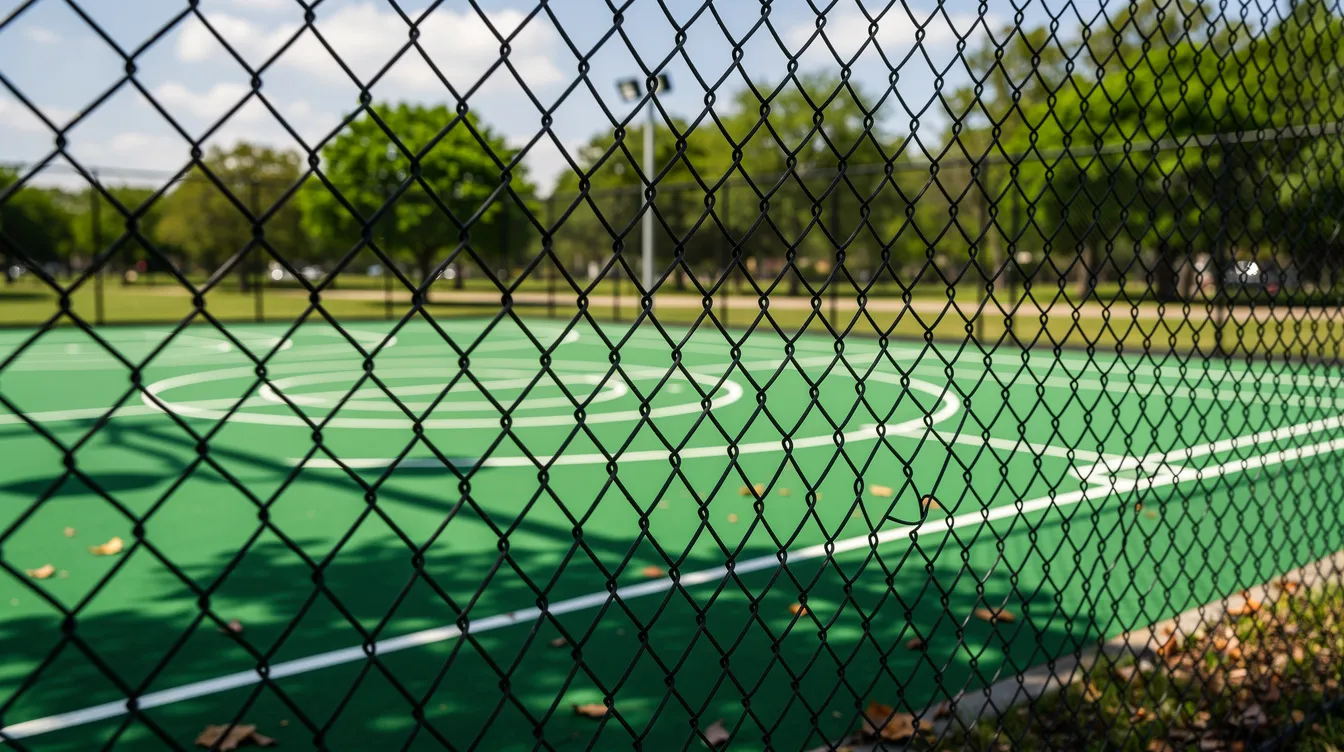
Chain link fencing can be used to contain balls and ensure spectator safety around sports facilities such as tennis courts and baseball diamonds.
Key Components: Chain Link Fence Fabric, Posts & Framework
Understanding each part helps you specify a suitable system instead of overpaying or underbuilding.
-
Fabric: chain link fence fabric comes in common 50 ft rolls, sometimes 75 ft, with 3, 4, 5, 6, and 8 ft heights.
-
Gauge: 11–12 gauge is common for residential; 9–9.5 gauge is better for commercial security. Lower gauge means thicker metal.
-
Posts: realistic sizes include 1-5/8” line posts and 2-3/8” corner posts; heavy industrial work may use Schedule 40.
-
Rails: top rails add support; bottom rails or tension wire reduce lift and sag.
-
Load matters: heavier mesh, taller height, privacy screens, and wind require stronger posts and deeper concrete footings.
-
Match all specifications so fabric, posts, rails, diameters, and fittings work as a combination.
Understanding Chain Link Fence Mesh & Aperture
Mesh size is the distance across each diamond opening in the fence fabric. It affects weight, cost, climbability, and security.
-
Standard chain link mesh is available in various aperture sizes, with the most common being 2 inches by 2 inches, but smaller sizes like 1 ½ inch and 1 inch are also available for higher security.
-
Larger 2-1/4” or 2-3/8” mesh is lightweight and cheaper.
-
Mini mesh, sometimes down to 3/8”, helps stop intruders, pets, and thrown objects.
-
Smaller mesh improves security and reduces climbing, but it adds weight, money, and framework load.
-
Example: community park baseball backstops and equipment yards often use smaller mesh with heavier posts.
Galvanized Steel & Other Chain Link Fence Finishes
The standard finish for chain link fences is usually galvanized steel, which provides protection against rust and corrosion. Zinc-coated steel extends durability and reduces weathering damage.
-
Hot-dipped galvanized wire and posts are common for residential and commercial work.
-
Heavier galvanizing is smart near coastal air, road salt, snow, or high humidity.
-
Chain link fences can also be coated with PVC to enhance their appearance and provide additional protection against the elements.
-
Black, green, and brown PVC-coated fabric can be paired with powder-coated posts, rails, and fittings.
-
Standard galvanized steel often lasts 15–25 years in non-marine climates; poorly coated imports may fail sooner.
-
PVC coatings should resist uv radiation, especially on sunny sites.
Choosing the Right Finish for Your Project
Finish affects attractive appearance, maintenance, and lifespan.
-
Opt for plain galvanized on budget installs, farmland, industrial yards, and storage perimeters.
-
Choose black or green vinyl-coated chain link for residential backyards, schools, parks, and playground settings.
-
Black or green vinyl-coated chain link fences blend more naturally into landscaping than bare galvanized steel, while premium steel fence options like Ameristar and Fortress focus more on security and architectural style.
-
Consider salt, snow, drainage, and sun exposure before choosing coating level.
-
Vinyl fencing is virtually maintenance-free but is typically more expensive than steel fencing with its durability and low maintenance advantages.
Pros and Cons of Chain Link Fences
Chain link fencing balances price, durability, and visibility, but it is not a true privacy fence. Weigh security, style, and budget before you add materials to cart.
-
Pros: low cost per linear foot, quick install, durable galvanized steel, low maintenance, visibility for safety, and modular repairs.
-
Pros: chain link fencing can last over a decade longer than wood fencing due to wood’s vulnerability to rot and pests.
-
Pros: chain link fences are often considered cost-effective compared to other fencing options, providing a secure barrier without a high price tag.
-
Cons: one of the main drawbacks of chain link fencing is its lack of privacy, as it does not completely block the view, which may not be suitable for all property owners.
-
Cons: standard chain link is relatively easy to climb, and determined intruders can cut through the wires with heavy-duty bolt cutters.
-
Cons: local permission, HOA rules, and zoning may limit height, color, or sharp surfaces.
-
Privacy slats, windscreen, or hedges can soften openness without replacing the fence.
Chain Link Fence Heights, Layouts & Typical Uses
Choose height and layout around property type, access, use, and local regulations.
-
3–4 ft: front yards, gardens, and low boundary fence projects.
-
4–5 ft: backyards, pet runs, and family areas.
-
6 ft: more secure residential yards or privacy screen support.
-
8–12 ft: commercial, industrial, sports fields, and storage yards.
-
Special projects such as tennis courts and baseball backstops may stack fabric to 15–20 ft or more, which is common in commercial and industrial fencing projects.
-
Plan property lines, corners, slopes, walk gates, and drive gates before ordering.
-
Example: a 200 ft boxed C or rectangle layout with two gates works for a suburban side yard or light commercial lot.
Common Applications for Chain Link Fencing
Chain link fencing is versatile across residential, commercial, municipal, and agricultural settings.
-
Residential: it is commonly used in residential areas to create secure environments for pets and children and can be part of a broader custom fence design for your home, as well as in commercial settings for security and visibility.
-
Farm and garden: chain link fencing is versatile and can be used for various applications, including securing farmland, gardens, and animal enclosures.
-
Commercial/industrial: chain link fencing serves as a primary deterrent against unauthorized access around storage yards, industrial sites, and commercial lots and can be integrated into a custom-built commercial fence solution.
-
Indoor: chain link fences can be installed inside buildings, making them suitable for use in warehouses and factories where areas need to be designated or protected.
-
Recreation: a 2024 school playground renovation might use 6 ft black chain link fence around play zones.
How to Install a Chain Link Fence (Step-by-Step Overview)
DIY installation is realistic for small runs, but large, sloped, automated, or high-security projects often deserve a contractor.
-
Confirm property lines, local codes, HOA rules, and utility locations before digging.
-
Most chain link fences are installed in one of three ways, which can depend on site conditions and security requirements: posts set in concrete, surface-mounted posts, or fabric secured at the bottom by trenching, but all rely on the same basic chain link fence structure.
-
Lay out stakes and string line, mark posts 7–10 ft on center, dig holes, and set posts in concrete.
-
In many northern states, footings may need 30”–36” depth to reach below frost.
-
Add top rail, bottom tension wire, and brace hardware.
-
Hang and stretch fabric using tension bars, come-alongs, and stretcher bars.
-
When installing a chain link fence, it is important to consider whether to add security features like barbed wire or to secure the bottom of the fence by burying part of the mesh in a trench.
-
Allow a full weekend for 100–150 ft with one gate.
Tools, Materials & Safety Tips
Good preparation makes installation safer and cleaner.
-
Tools: post-hole digger or auger, level, tape, string line, wrenches, pliers, come-along, and concrete tools.
-
Materials: fence fabric, posts, rails, brace bands, tension bands, tension bars, rail ends, caps, ties, hinges, and latches.
-
Wear gloves and eye protection; cut wire ends can be sharp surfaces.
-
Keep children and pets away from the worksite.
-
Recheck every measurement before concrete sets.
-
Supplier faq note: if a page, cart, or server shows an http or edgesuite error, verify specifications before ordering.
Chain Link Fence Gates & Accessories
Gates and accessories determine daily access, security, and convenience.
-
Chain link gates are typically manufactured to custom sizes for each project, allowing for flexibility in design and application.
-
Common gates include 3’–4’ walk gates, 10’–16’ double swing drive gates, and rolling or cantilever gates.
-
Chain link fence gates usually use matching galvanized steel tubing and chain link fence fabric.
-
Different types of hinges and latches are available for chain link gates, catering to various security and functionality needs.
-
Chain link gates can be automated, which is a popular option for commercial properties and storage facilities, enhancing convenience and security.
-
Accessories include acorn caps, dome caps, privacy slats, windscreen, tensioners, binding wire, and barbed wire arms.

Upgrades: Privacy, Security & Aesthetic Options
Bare chain link can be upgraded for privacy, security, or style.
-
Privacy: add vertical or horizontal slats in green, tan, or black, but remember they increase wind load.
-
Screening: windscreens are common on sports courts and construction sites.
-
Security: use smaller mesh, heavier gauge fabric, stronger posts, or three-strand barbed wire where legal.
-
Aesthetics: match coated posts and fabric, use decorative caps, and add landscaping.
-
Chain link fences can be adapted to different heights and mesh sizes, making them suitable for a range of needs from low garden fences to high security enclosures.
Cost, Maintenance & Lifespan of Chain Link Fencing
Total cost depends on height, length, gauge, finish, terrain, gates, and DIY versus contractor labor.
-
Recent U.S. averages: 4 ft galvanized may cost $8–$12 per foot installed; 6 ft galvanized may cost $12–$18 per foot, while color-coated systems can be higher.
-
Labor often equals or exceeds materials where digging is difficult.
-
Maintenance: inspect loose ties, rust, damaged mesh, leaning posts, and gates.
-
Clean with mild soap and water when needed.
-
Quality galvanized chain link fencing is known for its durability and low maintenance requirements, making it a practical choice for many applications.
-
Set posts for drainage and avoid soil buildup around bases to reduce corrosion.
When to Repair vs. Replace a Chain Link Fence
Repairs are one reason chain link remains practical.
-
Repair: cut or bent fabric, one broken rail, a damaged gate, or isolated rust.
-
Replace: widespread corrosion, many leaning posts, or unsafe gates.
-
As a rule, damage under 15–20% of total length is often repairable.
-
A pro can usually replace a few feet of fabric or one gate panel cost-effectively.
Choosing the Right Chain Link Fence for Your Property
The right fence matches material, height, mesh size, finish, and security level to the property’s real use.
-
Start with your goal: contain pets, define a line, secure equipment, protect children, or control commercial access.
-
Typical backyard: 4–6 ft height, 11 or 9 gauge galvanized steel fence fabric, 2” mesh, standard galvanized posts.
-
Small commercial yard: 6–8 ft height, 9 gauge chain link fence fabric, 2” or smaller mesh, Schedule 40 posts, optional barbed wire.
-
For coastal, sports, industrial, or high-security projects, check codes and consult a fencing professional.
-
If you want a secure barrier without losing airflow or visibility, chain link is still an ideal, durable choice.
